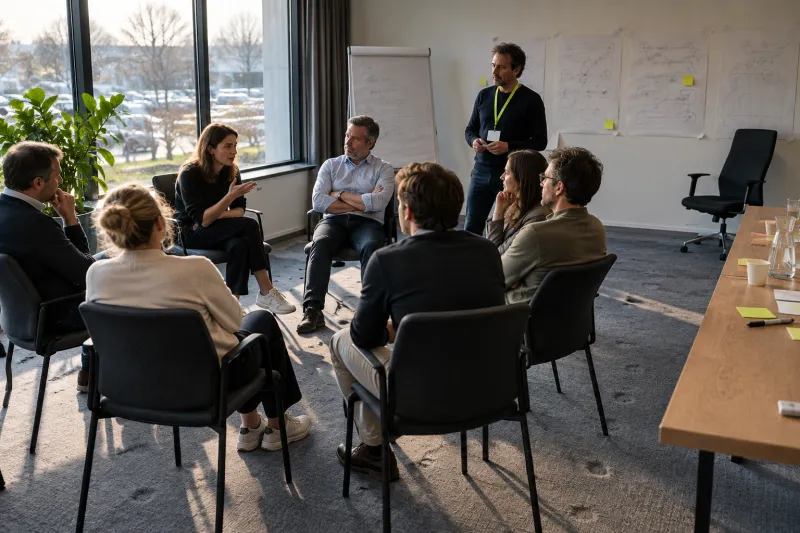
Mention a customer journey workshop and most B2B leaders picture sticky notes on a wall. Colourful arrows between touchpoints, and a team nodding at the obvious: awareness leads to consideration, consideration leads to purchase.
B2B doesn’t work that way. Your buyers don’t stroll down a funnel. They stumble, circle back, drop out, get pulled into procurement detours, and sometimes reappear months later with a new decision-maker at the table. The customer journey is a labyrinth.
Why most journey workshops fail
The problem isn’t the tool. It’s the mindset. Most workshops are borrowed from consumer marketing. They assume one person makes the decision, that emotion drives action, and that a smooth experience is enough to close the deal.
In B2B, none of that holds. Decisions are collective, stretched over time, and always under the shadow of risk. A CFO cares about cost. A technical lead worries about integration. A user cares about ease of use. If one of them hesitates, the deal stalls.
Which is why generic journey mapping ends up in a drawer. It describes an idealised path rather than the messy reality of how organisations buy.
What a B2B journey really looks like
Think of it less as a funnel and more as a chess game. Every move triggers a counter-move. An enthusiastic marketing manager might be in love with your solution, only to be blocked by IT security. A signed-off budget can still be frozen by finance. Silence after a demo might be the sound of your prospect navigating their own internal politics.
In most B2B journeys the real competitor is the inertia of doing nothing, rarely another vendor. The endless cycle of meetings, risk avoidance, and “let’s wait until next quarter”. Mapping that reality means accepting that time is as much an obstacle as price.
What a workshop should actually deliver
A B2B customer journey workshop is about decisions, and the diagrams are only there to make them visible. Done right, it reveals where friction slows deals down, where trust breaks between your brand and the buying group, and where speed creates real advantage.
At WIT, our workshops go past description. We frame the journey as a decision-making system: who holds influence, when alignment is possible, and how to design messages that land with different roles in the room. You walk out with a playbook.
Why strategy workshops save time
The irony is that most teams resist these workshops because they “take too much time”. Yet the absence of shared understanding wastes far more. Misaligned teams chase the wrong prospects. Marketing and sales argue over what stage a lead is in. Leaders decide in the dark.
A well-run workshop is the shortcut. It saves cycles by getting everyone around the same reality. It turns your marketing strategy into a set of deliberate, testable actions instead of a series of guesses.
Don’t draw the ideal
If your customer journey still looks like a funnel, you’re drawing a wish rather than mapping reality. In B2B the real journey is made of slow moves, silent pauses and sudden accelerations. The workshop makes that journey usable. It rarely makes it pretty.