The best workshops get interrupted. Yes, interrupted. By an outsider.
Your team is smart and engaged enough. It’s the internal dynamics that are sometimes just too strong. Hierarchies, histories, hallway alliances, internal teams struggling for scarce resources: they all sneak into the room, whether you invite them or not.
An outsider brings air
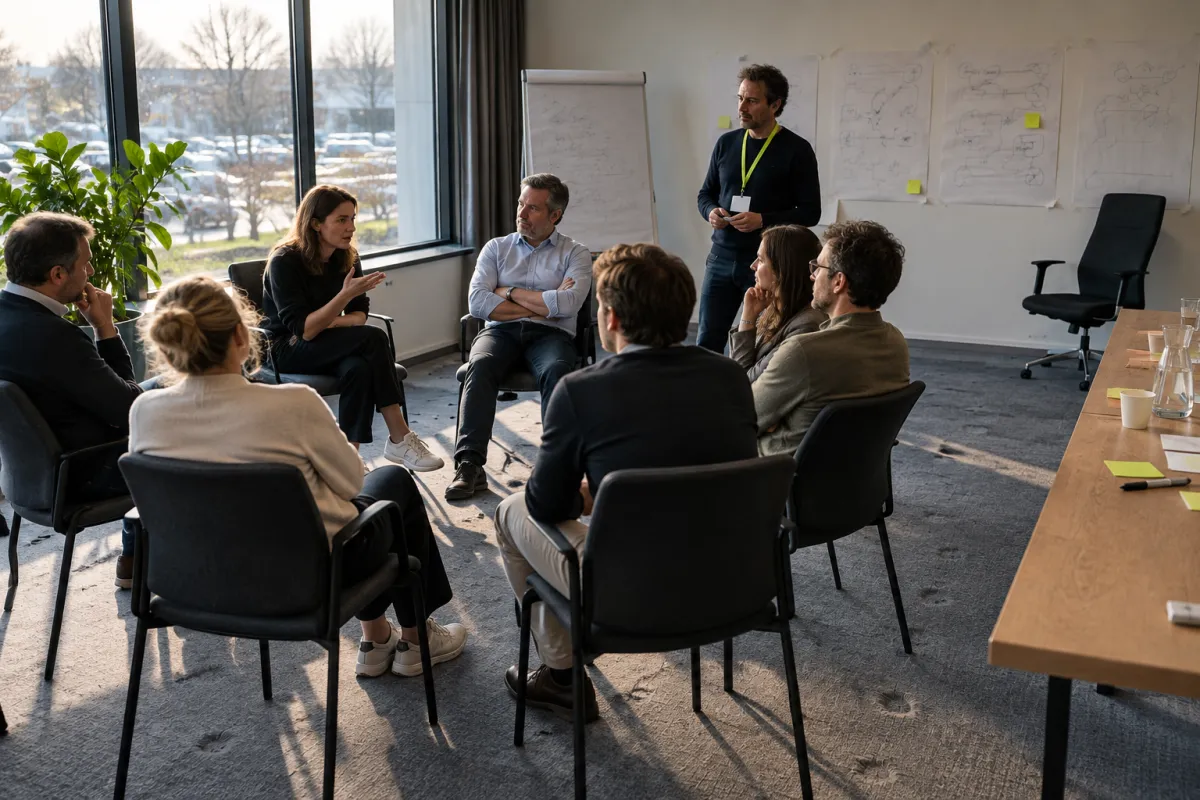
The outside facilitator is not your boss. You’re not his. He doesn’t know who always has the final word, who hasn’t spoken in six months, or who’s quietly updating their CV. And because he doesn’t carry that weight, he can do what internal leaders rarely dare: silence the loud, invite the quiet, call bullshit on vague thinking, and ask the one question everyone’s been avoiding.
Because when you’re not jockeying for position, you can focus on the problem. When it isn’t your colleague steering the session, you can take risks. Say the unpopular thing. Say the smart thing. Say the obvious thing no one has dared to say yet.
The freedom of not being involved
It’s no coincidence that some of the best strategic breakthroughs don’t happen at the office either. They happen off-site, with a neutral guide, a big whiteboard, and no laptops in sight.
The outsider’s power doesn’t lie in knowing your business better than you do. It lies in not being your business. He doesn’t have to manage team morale the next day. He won’t be in next week’s budget meeting. He’s there to get to clarity, not consensus.
And that makes all the difference.
Which way a workshop bends
Because when the workshop is run from the inside, it bends toward politics, or comfort, or speed. When someone from the outside leads it, with permission to provoke and a mandate to simplify, the session bends toward truth.
Away from “what we’ve always done.” Away from “what’s easy to execute.” Towards “what’s worth doing next.”
Let someone else hold the pen
The point of a good workshop isn’t to walk out with empty sharpies and a huge sheet of paper full of post-its. It’s to walk out with a plan and a conviction.
Conviction doesn’t come from collecting everyone’s opinion like it’s a vote. It comes from creating the right pressure, in the right moment, with the right outsider who knows when to stop the discussion and when to go half an hour over time to get it just right.
So if you’re planning a strategy workshop and you want real focus? Start by stepping aside. Let someone else hold the pen. You’ll be surprised how much more your team contributes when they’re not the ones expected to lead.