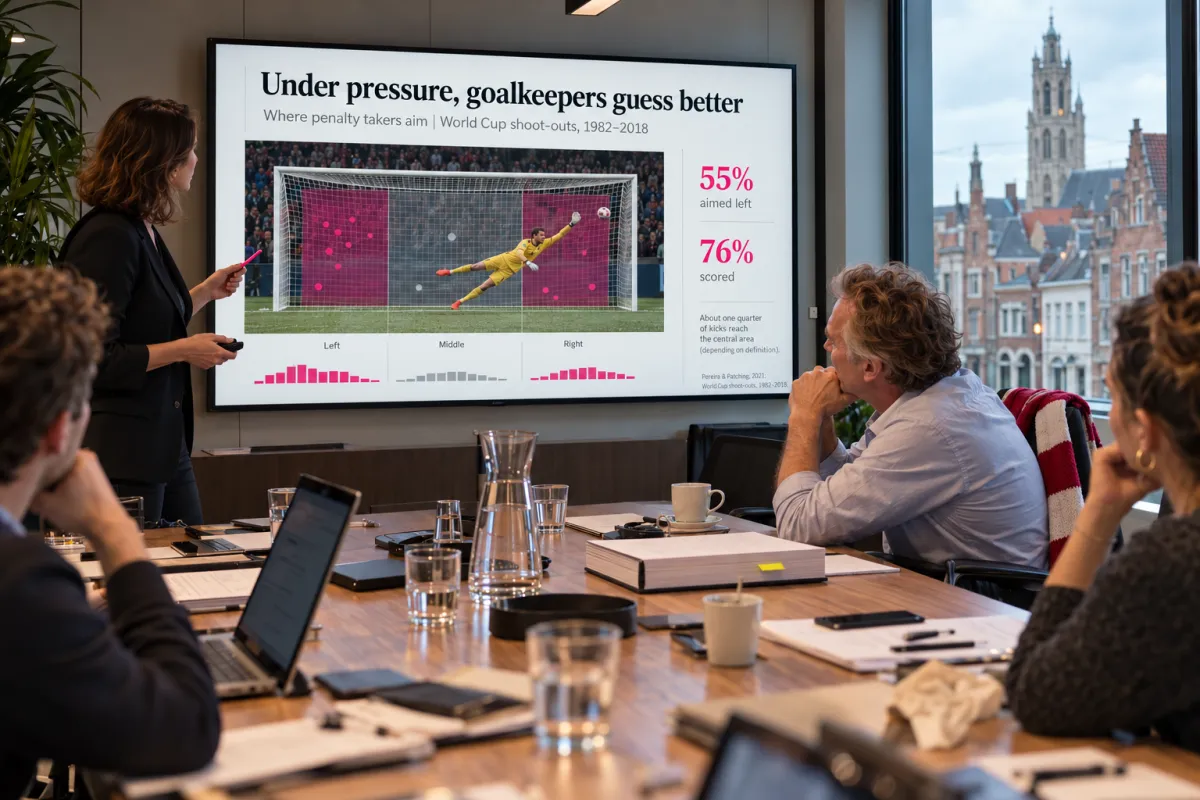
I’m not here to convince you that marketing is like football. But I did read a study that made me smile.
It’s called “The Role of Past Information, Time, and Emotional Pressure in Heuristic Decision-Making” and it uses data from La Liga penalty kicks to explore how people, or goalkeepers at least, make decisions when the clock is ticking and the stakes are high.
A strange choice? Maybe. A refreshing one too. Instead of having a group of students click through a lab experiment, the researchers looked at real, messy behaviour under real pressure. In a stadium. With reputations on the line. And thousands of fans in the stands who care nothing for statistical significance.
Heuristics, but with football shoes on
At its core, the paper is about how we decide when things get tense. Under time pressure, do we choke? Or do we lean into gut feel, habits, training, instinct?
Turns out, if you’re a goalkeeper, pressure might actually help. Especially late in the game, when everything speeds up. The study found that goalkeepers under time pressure were more likely to guess correctly and less likely to concede. Focus sharpens. Patterns kick in. The mind filters noise fast.
The twist sits with the kickers. The ones taking the shot became more error-prone under that same pressure. Mistakes increased. Composure wavered. Advantage for the keeper.
So pressure doesn’t make everyone better. It reveals where the cracks are and where the training shows.
From football field to boardroom (with detours)
Do I think this study rewrites what we know about decision-making or marketing behaviour? No. Do I think penalty kicks are a good metaphor for brand strategy? Also no.
The value sits in how the study frames the question. It doesn’t try to fake real life in a lab. It looks at real life directly. Human behaviour in the wild, imperfect and honest.
Because if we want to understand how people actually decide, and not just how they say they decide, we need more of this. More behavioural science with sweat stains. With noise. With risk. With cheering or booing crowds.
Would I use this in a strategy?
Probably not. Would I bring it up with a client who loves football? Definitely.
Reading research isn’t always about changing your strategy. Sometimes it’s about sharpening your intuition. Or reminding yourself that people are gloriously inconsistent. Even when the goal is right in front of them.